Outer Mongolia
The Wind-Up Bird ChronicleOuter Mongolia is both a contested borderland in the wartime account of Lieutenant Mamiya and the setting of the well ordeal that, in his later understanding, changed the course of his life. Its wide, difficult terrain makes military maps and supply calculations consequential, while the concealed crossing of the Khalkha River carries Mamiya’s party from disputed ground into enemy territory. The experience culminates in captivity and a brief encounter with light at the bottom of a dry well, which Mamiya regards as a lost revelation that left him living afterward in an empty shell.
Borderland and military setting
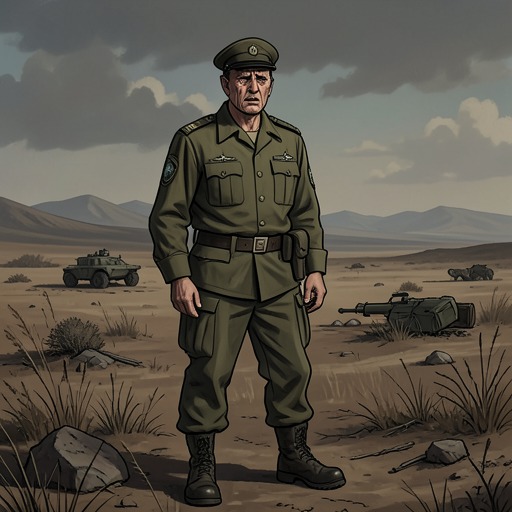
In the years before the Battle of Nomonhan, the western border of Manchukuo with Outer Mongolia remained uncertain. The terrain was immense, and the Mongolian nomads who had lived across it for generations had not needed the idea of fixed borders. At the same time, both the Soviet Union and Outer Mongolia treated incursions seriously, and clashes had already made the unresolved boundary a political and military danger.
The uncertainty shaped the work of the army’s surveyors. Lieutenant Mamiya’s official responsibility was to improve topographical maps of the border district, but existing maps of the Hulunbuir Steppe were crude, and asserting a definitive frontier could provoke an international incident. The Kwantung Army therefore tolerated ambiguity while it concentrated its forces on the war in China and sought to stabilize Manchukuo. Yet Mamiya recognized that if war came, maps would have to support actual operations: choosing campsites and artillery positions, estimating infantry travel, locating water, and calculating feed for horses. The same landscape that made borders difficult to define also made accurate logistical knowledge essential.
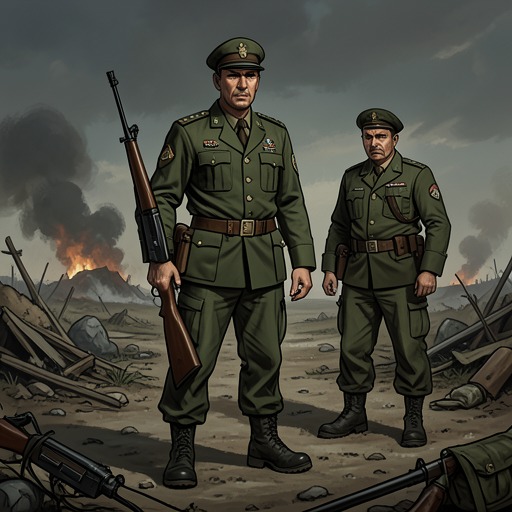
Mamiya’s expedition set out from Hsin-ching by train to Hailar, then continued by truck to a border observation post near the Khalkha River. The party’s small size was meant to avoid attracting notice from Outer Mongolian forces. Mamiya was assigned to command the escort because he had studied the region’s topography; Hamano supplied the party’s principal combat experience, while Corporal Honda’s particular value was not yet apparent to Mamiya. Across the steppe, the lack of recognizable landmarks made it difficult to match the map to the ground, underscoring the limits of surveying a landscape that seemed to offer no fixed points.
Crossing the Khalkha River
After two days moving south along the river, Yamamoto told Mamiya that the party would cross before dawn. Mamiya objected: the far bank was Outer Mongolian territory, where the group would have no plausible justification if captured, and the swollen, cold river seemed dangerous to ford. He also lacked clear authorization from his superior for a border violation. Yamamoto answered that responsibility had been settled at the highest levels of the army and said he knew a concealed crossing point he had used before.
At the secret ford, a plank bridge was held in place by ropes beneath the water. It was designed so that a small drop in the water level could allow vehicles to pass, while reconnaissance planes would not readily detect it. Yamamoto crossed first to check for patrols; the others followed by gripping the ropes as they negotiated the current with their horses. Once on the far bank, they stood on higher ground with a broad view of the desert they had left behind. Mamiya later connected this difference in elevation to the Soviet Army’s advantage in the coming Battle of Nomonhan, including the effect it could have on artillery accuracy. Soon after the crossing, the party removed its rank insignia, and Mamiya exchanged his officer’s boots for gaiters, practical precautions in enemy territory.
The well and Mamiya’s ordeal
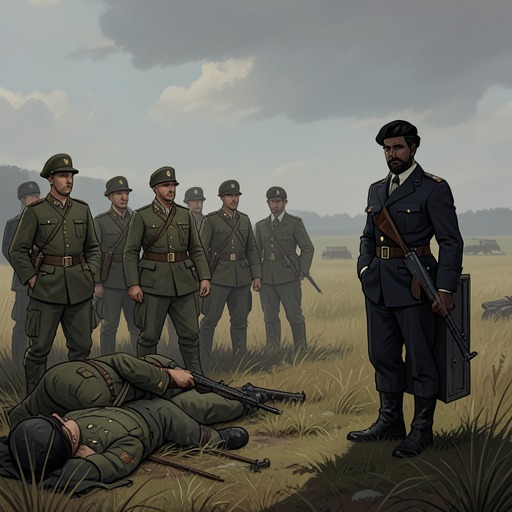
After his capture, Mamiya was taken to a well beside a Lamaist devotional mound. Its stone curb rose about three feet above the ground. When a rock dropped into the shaft landed on sand, he understood that the well had long been dry, apparently after an underground water vein shifted. Its depth and darkness marked the place as a site of confinement rather than rescue; Mamiya was forced to kneel beside it while his captors prepared to kill him. Instead, the account’s course led to his being thrown into the deep well, with a broken leg and shoulder and no food or water.
Years later, Mamiya told Toru Okada that the well’s darkness and the ordeal surrounding it had become the central dividing point in his life. He remembered a strong beam of sunlight reaching the bottom for only seconds, then vanishing. His explanation remained explicitly tentative: under extreme conditions, he believed his consciousness had concentrated enough for him to approach its own core. In the brief light, something living seemed to be forming, as if it might bring a form of grace or revelation, but it disappeared before he could discern it. The same incomplete emergence occurred on two successive days. He describes his lasting anguish not simply as hunger or thirst, but as the inability to see what seemed to matter most.
Aftermath and significance
Mamiya came to regard the unfulfilled revelation as the loss of his life in a spiritual sense. After leaving the well, he experienced the decades that followed as an empty interval: he lost a hand in battle, endured a Siberian labor camp, returned to Japan, and spent thirty years teaching social studies at a rural high school before living alone and working the land. He said that these years felt unreal beside the vivid memory of the steppe. Although Corporal Honda had predicted that Mamiya would not die on the continent, Mamiya later understood that survival had become a curse: he could not die, despite feeling that physical death might release him from his existence as an emptied person.
In the novel’s larger pattern, Outer Mongolia links the strategic realities of war to the private consequences of historical violence. The border is not an abstract line: its uncertain status governs the mission, the secret ford determines where the party can be captured, and the terrain’s elevation becomes part of Mamiya’s account of later battle. The well then transforms the landscape into a threshold of darkness and brief illumination. Mamiya’s story gives that image a distinct meaning: the light does not provide lasting knowledge or recovery, and its disappearance becomes the measure of what he believes he lost.